

AI’s “Google Moment” May Still Be Ahead

Why ChatGPT May Have a Google Problem
You probably didn’t notice a recent farewell note from a once-popular internet brand.
I almost missed it myself.
Go to Ask.com today and instead of a search box, you’ll find a simple message:
“Every great search must come to an end.”
After nearly three decades, Ask.com officially shut down on May 1.
But depending on your age, you may remember it by a different name: Ask Jeeves.
Back in the early days of the internet, Jeeves was the friendly digital butler who promised to help you find whatever you were looking for online.
But he wasn’t the only helpful name. Maybe you used these search engines…?
- AltaVista.
- Lycos.
- Excite.
- WebCrawler.
- Yahoo.
If you were online in the late 1990s, you likely used at least a few of them.
Today, most are gone or barely recognizable, but at the time, these weren’t obscure internet startups. They were how we navigated the World Wide Web.
By the late 1990s, you might reasonably have concluded that the search-engine business was already getting crowded, but then two Stanford graduate students came along with yet another one.
Google.
You know what happened next.
Google was faster, simpler and extraordinarily good at finding what people were actually looking for.
Gradually, those familiar names began disappearing.
AltaVista shut down. Lycos faded from prominence. Ask Jeeves became Ask.com and eventually abandoned its own search technology.
Google became so dominant that its name became a verb.
We don’t say, “I’ll search for that.” We say, “I’ll Google it.”
But it’s easy to overlook something in that history. Google didn’t invent the search engine. It wasn’t even particularly early to the game.
Google provided a better way of doing something millions of people were already doing.
And I’ve been thinking about that a lot lately, because right now, we may be watching a remarkably similar story unfold with AI. ChatGPT has become so closely associated with AI that the two terms can almost seem interchangeable.
But what if consumers are making the same mistake people made with those early search engines?
What if the technology that first popularizes a revolution isn’t necessarily the technology that ultimately dominates it?
AI’s Google Moment
I am not saying ChatGPT is about to disappear or that it will meet the same fate as AltaVista.
OpenAI deserves enormous credit for introducing millions of people to the possibilities of generative AI. But remember, Yahoo didn’t disappear the day Google arrived, either.
Better technology simply begins to take more market share.
First, someone develops a better approach and only a relatively small number of people notice. Then usage begins to grow, and that’s where the money flows. And seemingly overnight, the technology everyone assumed would dominate suddenly has a serious challenger.
That’s why I’m paying close attention to what legendary growth investor Louis Navellier is seeing in AI right now.
Louis has spent more than four decades studying the forces that can turn relatively unknown companies into some of the market’s biggest winners.
For example, it’s easy to forget now that when Louis first recommended Nvidia (NVDA) to his Growth Investor subscribers, the stock was selling for $4.19. Today it sells closer to $220 per share.
Quanta Services (PWR) is another example.
Louis recommended the infrastructure company in May 2021 because he saw how it could benefit from the rollout of 5G. But that same electrical infrastructure has since become critical to another technological revolution: AI.
Quanta helps upgrade the electrical grid and build the infrastructure needed to power today’s enormous data centers.
Since Louis recommended the stock, it has climbed 400%.
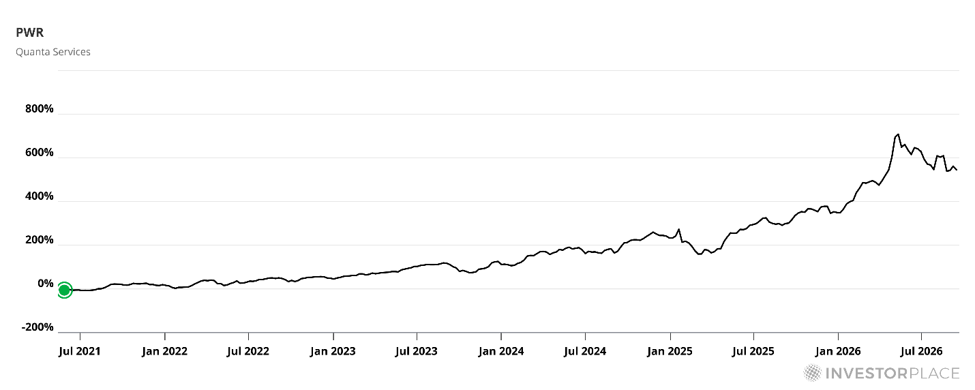
That’s the pattern Louis is looking for again today.
And lately, he’s been investigating a new AI technology that he believes could represent the next major leap beyond the AI systems millions of us use today.
In fact, he believes its advantages are potentially so significant that he’s given it a provocative nickname:
The “ChatGPT Killer.”
He believes we could be reaching another one of those moments when the technology that introduced millions of people to a new idea gives way to an even more powerful second act.
Think back to those search engines.
By the time Google arrived, the opportunity wasn’t “search engines.” Those already existed.
The opportunity was a better search engine.
And if Louis is right, we could be approaching a similar inflection point in AI.
The opportunity is simply “AI.” The question is what comes next.
That’s why Louis recently put together a special presentation explaining what he believes is happening behind the scenes.
He reveals the breakthrough he believes could challenge today’s dominant AI models… why it could spread much faster than most investors realize… and, most importantly, the little-known company he believes could become one of its biggest beneficiaries.
Because as exciting as it is to speculate about what comes after ChatGPT, that isn’t why Louis has spent so much time investigating this shift.
He wants to know who could make money from it.
And that’s the question that should matter to us, too.
He’s revealing the full story – including the name and ticker of that company – in his special presentation.
Click here to see Louis’ “ChatGPT Killer” presentation now.
I can’t promise we’re witnessing another Google.
Nobody could have known that with certainty in 1998, either.
But that’s precisely why opportunities like this can become so valuable.
By the time everyone recognizes the winner, the biggest part of the opportunity may already be behind you.
Click here to see what Louis believes could come after ChatGPT — and the company he’s recommending to profit from it.
Enjoy your weekend
Luis Hernandez
Editor in Chief, InvestorPlace
The post AI’s “Google Moment†May Still Be Ahead appeared first on InvestorPlace.


