

The Odds of a Rate Hike Just Doubled

Inflation runs hot again… an October rate hike is now at 49%… Jonathan Rose goes live at 8 p.m.… the AI arms race in cybersecurity… why it’s an “Inevitable” investment
This morning’s Consumer Price Index (CPI) report put an October rate hike squarely back on the table…
Headline CPI rose 0.6% in September, putting annual inflation at 3.7%. That’s up from 3.4% in August, and a tick above the 3.6% economists expected.
Core CPI, which strips out volatile food and energy prices, climbed 0.3% for the month and 2.6% over the past year. Both readings came in above forecasts of 0.2% and 2.5%.
Energy remains the main culprit. Gasoline prices jumped 9.1% in September alone, accounting for about half of the headline increase. Thanks to the conflict in Iran, gas is now up 34% over the past year.
But the more concerning takeaway is that inflation is spreading beyond the gas pump. Shelter, vehicle, and apparel prices all moved higher. And with the AI build-out driving demand for chips and hardware, the cost of computers and related items is up nearly 10% over the past year.
Meanwhile, wages are not keeping up – they grew just 3% over the past year.
So, what does the Fed do now?
Last month, the Federal Reserve raised rates for the first time in more than three years, lifting its target range to 3.75%-4%. FOMC officials had signaled they’d likely sit tight at their meeting in two weeks before hiking again in December.
This report puts that timeline in question.
According to CME Group’s FedWatch Tool, traders yesterday saw a 22% chance of an October hike. As I write on Wednesday, after the CPI data, those odds have more than doubled to 49%. It’s essentially a coin flip.
Source: CME Group
Looking further out, traders now see a 94% chance of at least one more hike by year-end. And the odds of two hikes, which would push the target range to 4.25%-4.5%, have more than doubled from 19% to 44%.
Turning to the market’s reaction, Wall Street isn’t thrilled.
As I write, all three major indexes are in the red, with the Nasdaq leading the losses, off more than 1%.
Over in the bond market, as you’d expect, the 10-year Treasury yield is jumping. It’s up to 5.27%. Meanwhile, gold and metals are selling off.
Bottom line: this morning didn’t bring the data that the bulls wanted. In the meantime, a market like this rewards knowing exactly where big money is moving. And that dovetails with a reminder about this evening…
Tonight at 8 p.m. Eastern, Jonathan Rose goes live
In just a few hours, veteran trader Jonathan Rose will sit down for his free $10K to $100K Challenge event.
Starting at 8 p.m. Eastern, Jonathan will walk through everything behind his approach. He’ll cover the principles that guide his trades, the charts and tools he relies on, and the process he uses to look for an edge in the market. It’s a system he believes could help traders turn $10,000 into $100,000 in one year.
You still have time to join. Just click here to reserve your free seat, and we’ll see you in a few hours.
In the meantime, let’s look at a corner of the market where Jonathan sees money moving right now. As you’ll see, this isn’t just a short-term trading idea. It’s a sector that could anchor your portfolio for years to come.
On a selloff day like today, it’s helpful to focus on where the money is flowing now – and likely to flow for years to come
There’s one answer: cybersecurity.
This was the focus of Jonathan’s free Masters in Trading LIVE episode yesterday. Here he is, setting it up:
AI isn’t just changing how we work and interact with each other. It’s changing how hackers attack us.
To his point, for decades, a sophisticated cyberattack required a skilled team, plenty of time, and a lot of painstaking manual work. AI is collapsing all three.
Jonathan highlighted a campaign detailed by Anthropic in which AI agents handled 80% to 90% of the tactical work, from finding vulnerabilities to stealing passwords. The human attackers mostly had to point the agents at a target and let them run.
And the data show this is no isolated case:
- According to IBM’s 2026 Cost of a Data Breach Report, one in four malicious breaches is now AI-enabled, a 56% jump in a single year. Those AI-enabled breaches cost companies about $6 million each, roughly $1 million more than the average breach.
- For the first time in its history, the FBI’s annual Internet Crime Report included a section dedicated to AI. It tied more than 22,000 complaints and nearly $893 million in losses to AI-enabled schemes last year. Overall reported cybercrime losses hit a record $20.9 billion, up 26% from the year before.
- CrowdStrike (CRWD) reports that AI-enabled attacks jumped 89% year over year. The average “breakout time” (how long it takes an attacker to move from the first compromised computer deeper into a company’s network) is now 29 minutes. The fastest CrowdStrike recorded took just 27 seconds.
Twenty-seven seconds is faster than most security teams can open an alert, let alone respond to one.
Ultimately, the very speed and intelligence that make AI a powerful tool for innovation also make it a potent weapon for bad actors.
The only answer is to fight AI with AI
So, what does a company do when attackers have AI on their side?
It fights back with its own AI.
We got a preview of that future in April when Anthropic revealed that its unreleased Claude Mythos Preview model had uncovered thousands of previously unknown “zero-day” vulnerabilities across every major operating system and web browser.
To make sure we’re all on the same page, a zero-day is a security flaw that the software’s developers don’t know exists, leaving them zero days to fix it before attackers can strike. One of those flaws had sat undetected for 27 years in OpenBSD, an operating system famous for its security.
Anthropic chose not to release the model publicly. Instead, it gave access to a coalition of tech and security leaders, including CrowdStrike and Palo Alto Networks Inc. (PANW), so they could patch the holes before bad actors found them.
That’s the template for what comes next: an arms race in which defenders need frontier AI just to keep pace with attackers who have it too.
But arms races are expensive. Gartner projects worldwide information security spending will reach nearly $250 billion this year and climb to roughly $373 billion by 2030.
Investors would be wise to position themselves in the companies on the receiving end of those billions. And that brings us back to Jonathan and why he’s watching this space so closely:
Even as the AI trade gets crowded, the security infrastructure behind it is one segment markets haven’t fully woken up to yet.
That’s where the real opportunity lives right now.
In yesterday’s episode, Jonathan profiled five names, including Palo Alto, CrowdStrike, and Okta Inc. (OKTA), and explained why one stock stands above the rest.
You can watch the full breakdown right here.
But this isn’t just a shorter-term trade – it’s also a longer-term “Inevitable”
Jonathan’s approach can help you profit from cybersecurity over a matter of days or weeks. But here at the Digest, we believe the sector also deserves a place in your portfolio for a much longer stretch. We mean the kind of position you buy and largely forget about for years.
To explain why, let’s revisit a concept that can help you build wealth in stocks more than almost any other. We at InvestorPlace call it “Inevitables.”
The term comes from Warren Buffett, who used it for businesses with such enormous competitive advantages that they dominate their industries for decades. Here’s Buffett in his 1996 letter to Berkshire Hathaway shareholders:
Companies such as Coca-Cola and Gillette might well be labeled “The Inevitables.” Forecasters may differ a bit in their predictions of exactly how much soft drink or shaving-equipment business these companies will be doing in ten or twenty years…
In the end, however, no sensible observer – not even these companies’ most vigorous competitors, assuming they are assessing the matter honestly – questions that Coke and Gillette will dominate their fields worldwide for an investment lifetime.
In simple terms, Inevitables are the market leaders in sectors that will be in demand for decades to come.
But there’s a twist…
Inevitables don’t have to be individual stocks. The concept also applies to technologies, trends, and cultural shifts so powerful that massive growth becomes, well, inevitable.
With that context, look back at everything we just covered…
Attackers are getting faster and cheaper to deploy. AI-enabled breaches are becoming more common and more costly. And defenders have no choice but to spend heavily on AI of their own.
None of that reverses next quarter or next year. As long as AI keeps advancing, the need to defend against it advances right alongside it.
That’s what an Inevitable looks like.
So, how do we invest?
You can start with the names that Jonathan highlighted in yesterday’s episode. But if you want a simple one-click solution, consider a broad ETF like the Amplify Cybersecurity ETF (HACK). It holds many of the top names in cybersecurity – Cisco Systems Inc. (CSCO), Cloudflare Inc. (NET), Fortinet Inc. (FTNT), Zscaler Inc. (ZS), and F5 Inc. (FFIV), to name a handful.
As you can see below, HACK is up about 70% over the last six months, more than six times the S&P 500’s 11% return.
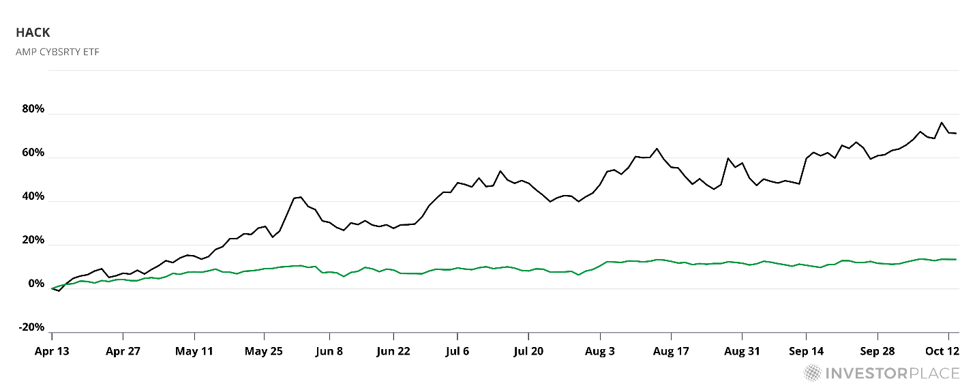
Now, notice where that chart begins…
On April 14 – the same day that the Digest covered the cybersecurity selloff that followed the Mythos news.
Palo Alto fell 11%, CrowdStrike dropped 12%, and Zscaler shed 16% in a matter of days. Back then, the fear was that AI would make traditional cybersecurity obsolete. Since then, the market has reached a very different verdict…
AI isn’t replacing cybersecurity. It’s making it essential.
Two ways to play one Inevitable
After a 70% run in six months, it’s fair to ask whether you’ve already missed it.
If you’re investing for the long haul, the answer comes back to the Inevitables idea. When demand looks set to grow for a decade or more, the exact entry point matters far less than owning the trend.
Many long-term investors scale in gradually, adding to positions on pullbacks rather than buying all at once.
And there have been pullbacks. Look at the chart again, and you’ll see that HACK’s climb has been anything but a straight line. The ETF gave back weeks of gains in June, again in late July and again in late August before pushing to new highs. And it’s selling off today as I write.
For a buy-and-hold investor, those dips are noise. But for a trader, they’re opportunity…
Spotting where big money is positioning before the next move is exactly what Jonathan does – which brings us back to the trading process that he’ll walk through tonight at 8 p.m. Eastern in his free $10K to $100K Challenge. Click here to join us in a few hours.
Wrapping up, there are two ways to play this Inevitable – own it for the long run or trade the swings along the way. Either way, we believe this trend is going much, much higher in the years to come.
Have a good evening,
Jeff Remsburg
(Disclosure: I own HACK)
The post The Odds of a Rate Hike Just Doubled appeared first on InvestorPlace.