

The Best Stocks to Buy on the Bounce After the ‘Leopold Low’

July’s crash in AI infrastructure stocks had a cause, a name, and a leverage ratio
Listen to the audio version of this article (generated by AI).
Does bad luck actually exist?
Physicists have spent a century attempting to get to the bottom of this question. At the subatomic level, the universe looks like pure chaos. You cannot predict when a single atom will decay. But hand that same physicist a sample of those atoms, though, and he will tell you exactly how long it takes for half of them to fall apart. The individual event looks random but the ensemble is not. And a growing camp of physicists argues the randomness was never really there at all – that particles obey probabilistic rules, and probabilistic rules are deterministic rules wearing a disguise.
Remove one convenient assumption from the math and what looked like chance turns back into cause and effect.
Which brings us to July…
If you owned AI infrastructure stocks last month, it felt like the worst luck imaginable. The first half of 2026 felt like the best of times. From Jan. 1 to about June 22, we were invincible. We were Superman with Lois Lane in our arms. Then, from June 23 into July 30, it felt like the worst of times. Shout out Charles Dickens. Semiconductor stocks put in the deepest drawdown since ChatGPT launched, excluding the Liberation Day anomaly. The VanEck Semiconductor ETF (SMH) fell roughly 25%. The iShares Semiconductor ETF (SOXX) fell closer to 30%. Individual names got cut in half.
And every headline told you the same story: the AI trade is falling apart.
Here is the thing. That selloff was not random. It had a cause, a name, and a leverage ratio. And once you understand the mechanics, you stop seeing bad luck and start seeing one of the three best entry points of this entire AI cycle.
We discuss this (and more) in our latest episode of Being Exponential with Luke Lango below:
The Leopold Low
Situational Awareness was a large hedge fund built on one premise: AI compute is structurally undersupplied and stays undersupplied for years. Founded by Leopold Aschenbrenner, a genuine prodigy – Columbia at 15, valedictorian at 19, a stint at FTX, then a top research seat at OpenAI before an ugly exit over leaked documents.
He was directionally right. The fund loaded up on the neoclouds, the power names, the memory names, the optics names. It ripped, reportedly surging thousands of percent.
Then optimism turned into greed, and belief turned into overconfidence. Aschenbrenner levered up, reportedly at least four to one.
Now, everyone on the Street knew this. Everyone knew Leopold as the super-levered AI fund. So when the AI trade started to crack in late June, put yourself in the seat of a rival portfolio manager who owns a lot of the same names. You look at his book, you look at his leverage, and you think: if this guy blows up, he liquidates into my positions and takes my marks down with him. So what do you do? You sell everything you have in common with him first. You let him blow up. Then you buy it back cheaper.
That is exactly what the flow data from Goldman Sachs Group Inc. (GS) and Bank of America Corp. (BAC) showed in late June and July – institutional selling in tech at genuinely extreme levels, with no obvious fundamental trigger. It was not a verdict on the AI trade. It was a fire drill ahead of a fire everybody could see coming.
The fire arrived. Situational Awareness reportedly dropped about 67% month to date in July, and the public equity book got offloaded to Citadel through the prime brokers.
That was the clearing event. Leverage gone. Book in strong hands. No liquidation left to fear. The news hit on a Wednesday. Thursday was the big bounce. We have been bouncing ever since, and those same funds that sold in July are now enormous net buyers of tech.
Not luck. Mechanics.
Intelligence Is Not Wisdom
When you own stocks without leverage, you only have to be directionally correct. Add leverage, and you introduce a timing requirement. Now you have to be right about direction and right about when. You lose the ability to absorb a hiccup.
Aschenbrenner had extraordinary intelligence, which is the ability to see what is true. He did not yet have wisdom, which is the preparation for being right too early. That is a completely normal thing to lack at 25, in your first turn managing outside money. Bill Hwang and Archegos learned it in 2021. Long-Term Capital Management learned it in 1998. Ken Griffin blew up early too, and it made him what he is. Leopold will be back, and he will be better.
No cabal. No conspiracy. Just a levered book meeting a bad month.
Yes, We Are in a Bubble. That Is Not the Question.
I get asked constantly about concentration, and I will give you the honest answer: the market is heavily concentrated, and yes, we are in a bubble. Everything about this is consistent with a bubble.
I do not care that there is a bubble. I care when it bursts. Telling me the market is concentrated gives me nothing actionable. Timing is the entire game.
And we have been consistent about the timing tell for two years now: this bust happens when the hyperscalers stop spending.
They are not stopping. Amazon.com Inc. (AMZN), Microsoft Corp. (MSFT), Meta Platforms Inc. (META), and Alphabet Inc. (GOOGL) all reported over the last two weeks. All four posted excellent numbers. All four raised capex guidance for 2026. All four gave directionally bullish commentary on 2027, and implied continued spending into 2028. Alphabet is seeing rising Google Search usage and better ad effectiveness because of AI. Meta is growing daily active people on an already ubiquitous platform. Amazon Web Services and Azure both carry enormous backlogs.
Run the return math on those AI investments and you get a two-year return on invested capital in the high 20s. Weighted average cost of capital for these companies sits around 8% to 10%, which puts the two-year hurdle at roughly 16% to 20%. They are clearing it with room to spare. That is why the spending accelerates rather than slows.
Think of it as a funnel. Hyperscaler capex is water poured in at the top. Every AI infrastructure stock you own sits downstream, catching what flows through. We just got confirmation from all four pourers that they keep pouring. So stay invested in the recipients.
The Numbers Never Budged
Here is the chart that settles it for me, and it is the same chart I keep coming back to:
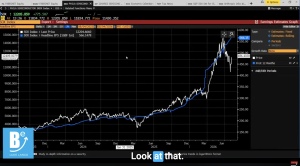
Stock price trends follow earnings estimate trends. The stock is not the company, and the company is not the stock, as Jeff Bezos put it in the wreckage of 2001. But the forward earnings estimate line tells you the underlying fundamental health of a business. When price detaches too far from that line, you get a buying opportunity.
Since June 23, forward earnings estimates for the Philadelphia Semiconductor Index have climbed roughly 10%. Over that same stretch, the index fell about 20%.
One of those two things has to give. Either estimates come down, or the stocks come back up. And estimates are not coming down, because the earnings are extraordinary and the capex funding them is rising.
That is what a fundamentally incongruent selloff looks like. That is why I have been telling subscribers this is backup-the-truck territory.
I will flag the honest counterargument, because it deserves one. In the 2022 tech wreck, price led fundamentals. Semiconductor stocks crashed while estimates kept rising, and then estimates rolled over and validated the crash. That is precisely what the market feared in July, and it is why beat-and-raise quarters were greeted with a shrug. The difference this time is that we heard directly from the companies funding the estimate line, and they told us they are spending more.
Where the Rebound Lands
Semis. Semis, semis, and then a little more semis.
Semiconductor stocks were the heartbeat of this market for three years. They took the worst of the July damage, which means they get the biggest snapback, and they are where the earnings growth actually is. Both SMH and SOXX have already retaken the 100-day moving average and broken the pattern of lower highs and lower lows. Oversold bounce, confirmed by the tape.
Underneath that, the individual Leopold Low names are the highest-torque way to play it. Bloom Energy Corp. (BE) put in a drawdown of roughly 50% while its forward estimate line went straight up and to the right, and it just reclaimed its 200-day. SanDisk Corp. (SNDK) fell about 56%, held the 200-day, knifed back through the 100-day, and took out its July lows to the upside.
On memory, I want to address the efficiency bear case directly, because it keeps coming up. Yes, the open-source models out of China are memory efficient. Yes, we get an efficiency breakthrough every few months. That is what new technology does. And every one of those breakthroughs triggers Jevons paradox – make a resource cheaper, and total consumption of it explodes. Efficiency gains are bullish for memory, not bearish.
Among the neoclouds, I recommend Nebius Group N.V. (NBIS) first and Applied Digital Corp. (APLD) second. APLD’s estimate line staged a sharp rebound that is completely incongruent with what the stock did. CoreWeave Inc. (CRWV) has the fundamental story right – we are compute short, and more supply is coming – but the chart has been stuck in neutral since the IPO, still below a flat 200-day. Good company. Better entries elsewhere.
One Thing to Watch
July also brought a broadening. The equal-weight index outperformed, and capital rotated into staples, discretionary, and software. A lot of people read that as a durable regime change.
I think it gets cut short. Capital is finite, and as the long end of the yield curve rises, it gets more finite. There is not enough of it to reconcentrate into AI infrastructure and broaden out simultaneously. So my rule of thumb: the dynamics that ruled from January to June are the dynamics to invest for. The dynamics of July are the ones to fade. What worked last month probably does not work from August to December, and what got crushed last month probably leads.
The universe may not deal in randomness. Neither does this market. Both just deal in causes most people never bother to trace.
For the full breakdown – the charts, the estimate divergences, and the complete list of Leopold Low names we are watching – listen to this week’s episode of Being Exponential.
In addition to the stocks I mentioned today, there is one $15 stock that could soar over the coming weeks and months. Hint: It involves Elon Musk, AI, China…
There will be a headline that spooks you. Similar stocks that drop for reasons that have nothing to do with the business underneath it. A moment where it looks, on the surface, like the story is falling apart.
That moment, if history is any guide, is exactly when the money that matters moves in.
The only question left is whether you’re positioned before that moment or after it. In fact, if you buy just one stock for the rest of the year, I urge you to make it this one.


