
Speculative student housing bonds go divergent ways


Yugo
Two speculative-grade Florida student housing bonds have gone down divergent paths over the last half year.
Processing Content
Moody’s Ratings downgraded Florida Capital Projects Finance Authority bonds issued for PRG-UnionWest Properties to B3 from Ba3 in late June following a draw on debt service reserves, retaining the negative outlook.
Meanwhile, Fitch Ratings in April affirmed its BB-plus rating with a negative outlook for Florida Development Finance Corp. bonds, SFP-Tampa I LLC and now says there are hopeful signs for the credit.
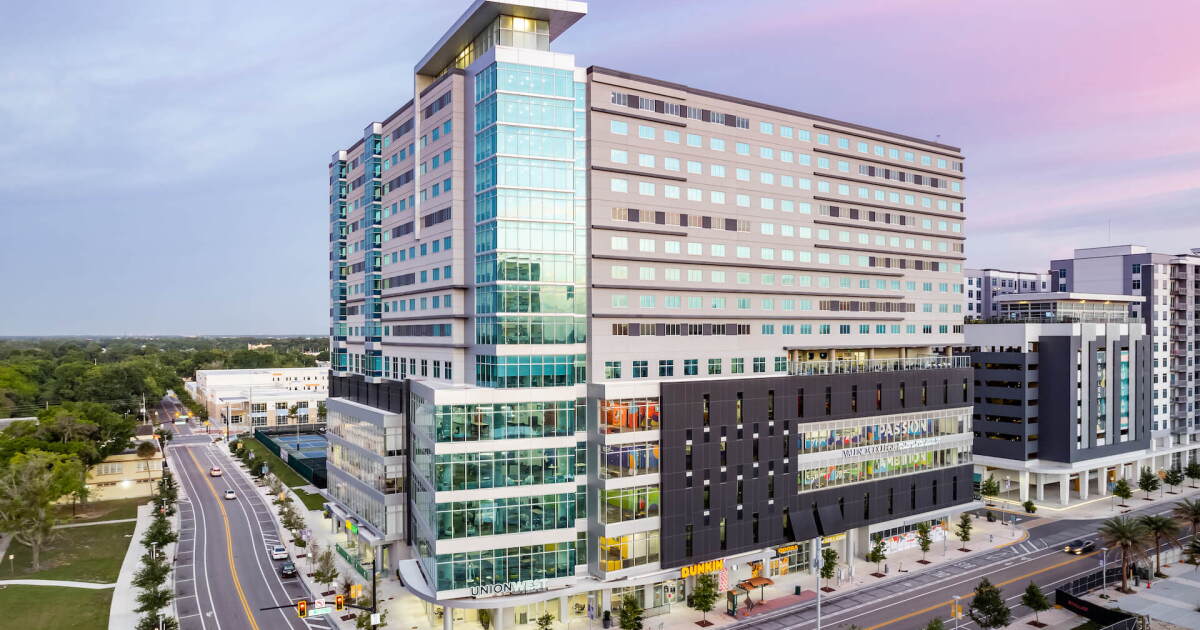
The PRG-UnionWest bonds were used to purchase and renovate a 15-floor mixed-use building, called UnionWest, in Orlando. It serves students of the University of Central Florida and Valencia College.
“PRG-UnionWest has a tougher situation,” said Joseph Krist, publisher of Muni Credit News. “Location, reputation and occupancy issues along with the unique nature of the building all make for a tougher story. It is a lot to overcome and there will clearly need to be an additional capital investment. It’s also kind of a unique situation in that the expectation is that many students treat Valencia more as a community college than a four year school.”
The PRG-Union West bonds consist of $109.3 million of Series 2024A-1 and 2024A-2 bonds. There are also $28.4 million of unrated Series 2024B subordinated bonds expected to have an accreted value at maturity in 2062 of $210.4 million.
The sole member of PRG-UnionWest Properties is Provident Resources Group.
In May
To explain its subsequent downgrade, Moody’s said there has been a significant and rapid decline in occupancy in the building. Occupancy was 68% in spring 2026, similar to fall 2025, much lower than the historic average of 95%.
“Additional and potentially larger draws on the debt service reserve are anticipated for fiscal 2026 and 2027 given limited near-term opportunities to substantively improve financial performance,” Moody’s said.
Moody’s said the building has poor conditions, poor design elements, and is comparatively distant from the campuses it serves. Recently, the student lease renewal rate has been 29%, which Moody’s characterized as low.
“Evolving market dynamics and increased competition from University of Central Florida main campus have put pressure on rental rates and lease-up,” said Chris Hicks, president and CEO of the borrower Provident Resources Group.
“Despite these challenges, we remain encouraged by the continued growth and investment occurring in the surrounding area, known as Creative Village, and the work management continues to do, actively pursuing marketing initiatives and outreach efforts designed to broaden the property’s appeal and improve performance over time,” he said.
“We believe these efforts, together with the continued development of Creative Village, position the project to benefit from increased demand over the long term,” Hicks said.
Trading
For its part, SFP-Tampa I LLC used the proceeds from the bonds primarily to purchase The Henry building in Tampa near the University of Tampa, a private school, and the University of South Florida’s Health Services campus.
“The SFP-Tampa I LLC bonds present a much less complicated situation and the two universities it serves appear to be more involved with marketing,” Krist said. “The orientation towards grad students helps. This credit also has somewhat more cash available. It’s a more flexible situation.”
SFP-Tampa has about $113.5 million of Series 2024A-1 and $13.1 million of Series 2024A-2 bonds outstanding.
Strategic Family Partners, an Ohio nonprofit, is the borrower for the SFP-Tampa I bonds.
“Operational and managerial improvements at SFP Tampa, including stronger leasing trends, better direct coordination with the University of Tampa and University of South Florida, and demand at The Henry that exceeds available capacity for some unit types, support Fitch’s view that the project’s credit profile is improving despite a competitive student housing market,” Fitch Ratings Director Eva Rippeteau said.
“These developments are credit positive because they should help drive stronger occupancy, revenue growth and performance across both housing and ancillary retail-related revenues,” she said.
“However, Fitch’s view remains constrained by weak fiscal 2025 results [covering the period through June 30, 2025], including a 1.05 times senior debt service coverage ratio and reserve draws that fully depleted the operations and maintenance reserve and weakened financial flexibility,” Rippeteau said. “As a result, while the project is making progress, Fitch believes more time and clearer evidence of reserve replenishment are needed before the outlook could be revised to stable.”
In Fitch’s April rating report on the bonds, it said, “The University of South Florida affiliation agreement aligns incentives through revenue sharing, marketing clauses preferential to the project, and facility handover to University of South Florida at the end of the 35-year term.”
Strategic Facility Partners President Richard Rieth said, “There has been 25%+ increase in resident satisfaction since we acquired the facility… We did not use any portion of reserve funds to make our June 2026 debt service payment. Since using some of the subordinate debt service reserve fund in December 2025 we have been actively refilling reserve funds.”
In other news about Southeast student housing bonds,
Moody’s cited weak demand for the housing. The outlook is stable, reflecting what Moody’s said was a modest reserve position that “should enable the project to avoid default in the near term.”
The bonds were issued as Series 2019A Louisiana Local Government Environmental and Commercial Development Authority student housing revenue bonds.
The facility has an 85% occupancy rate, which Moody’s described as low. Debt service coverage was 0.98X as of Dec. 31, 2024, resulting in draws on the debt service reserve, which has been periodically replenished when occupancy has strengthened.
Provident Resources Group is the obligor for the ULM bonds.
“While the project has faced challenges and occupancy levels have not reached the thresholds needed to fully support operations and debt service, management has remained focused on the long-term viability of the asset,” Hicks said, “The team is encouraged by recent pre-leasing activity, which has reached approximately 93% heading into the fall.
“Additionally, Monroe, Louisiana and the surrounding community is benefiting from significant economic investment, which we believe has contributed to stronger demand for on-campus student housing,” Hicks said.
The student housing developments take place in a difficult period for higher education.
Moody’s said less prominent schools will have a more difficult time managing the stresses than leading schools.
In December, Fitch said the outlook for public universities is deteriorating. It cited pressures on student enrollment, uncertainty of state and federal support, continued expense escalation and shifting economic conditions. It said revenue growth prospects for 2026 are strained.